
Bacchylides
Greek lyric poet of clarity and simplicity, rival of Pindar.

Bacchylides · Public domain
Bacchylides (c. Later Greeks included him in the canonical list of Nine Lyric Poets, which also included his uncle Simonides. His lyrics are noted for their clarity in expression and simplicity of thought, making them an ideal introduction to the study of Greek lyric poetry. His career coincided with the ascendency of dramatic styles of poetry, and he is considered one of the last poets of major significance within the more ancient tradition of purely lyric poetry.
- field
- Lyric poetry
- nationality
- Greek (from Ioulis, Keos)
- known_for
- Member of the Nine Lyric Poets; clarity and simplicity of his lyrics; rivalry with Pindar
Lore & Background
Bacchylides was born in Ioulis on the island of Keos. His mother was the sister of Simonides. Details of his father are contradictory: according to Suda his father was Meidon, while Etymologicum Magnum gives Meidylus. His grandfather, also named Bacchylides, was claimed by some later sources to be a famous athlete, but this is not supported by reliable ancient evidence and is considered dubious. According to Plutarch, he was banished for a time from Keos and spent this period as an exile in Peloponnesus, where his genius ripened. This account is considered credible based on literary evidence. His career probably benefited from the high reputation of his uncle Simonides, who introduced him to ruling families in Thessaly and to the Sicilian tyrant Hieron of Syracuse. His first notable success came after 500 BC with commissions from Macedonia for a symposium song. He competed with Pindar for commissions, notably for odes celebrating Hieron's victories.
Reader's Guide
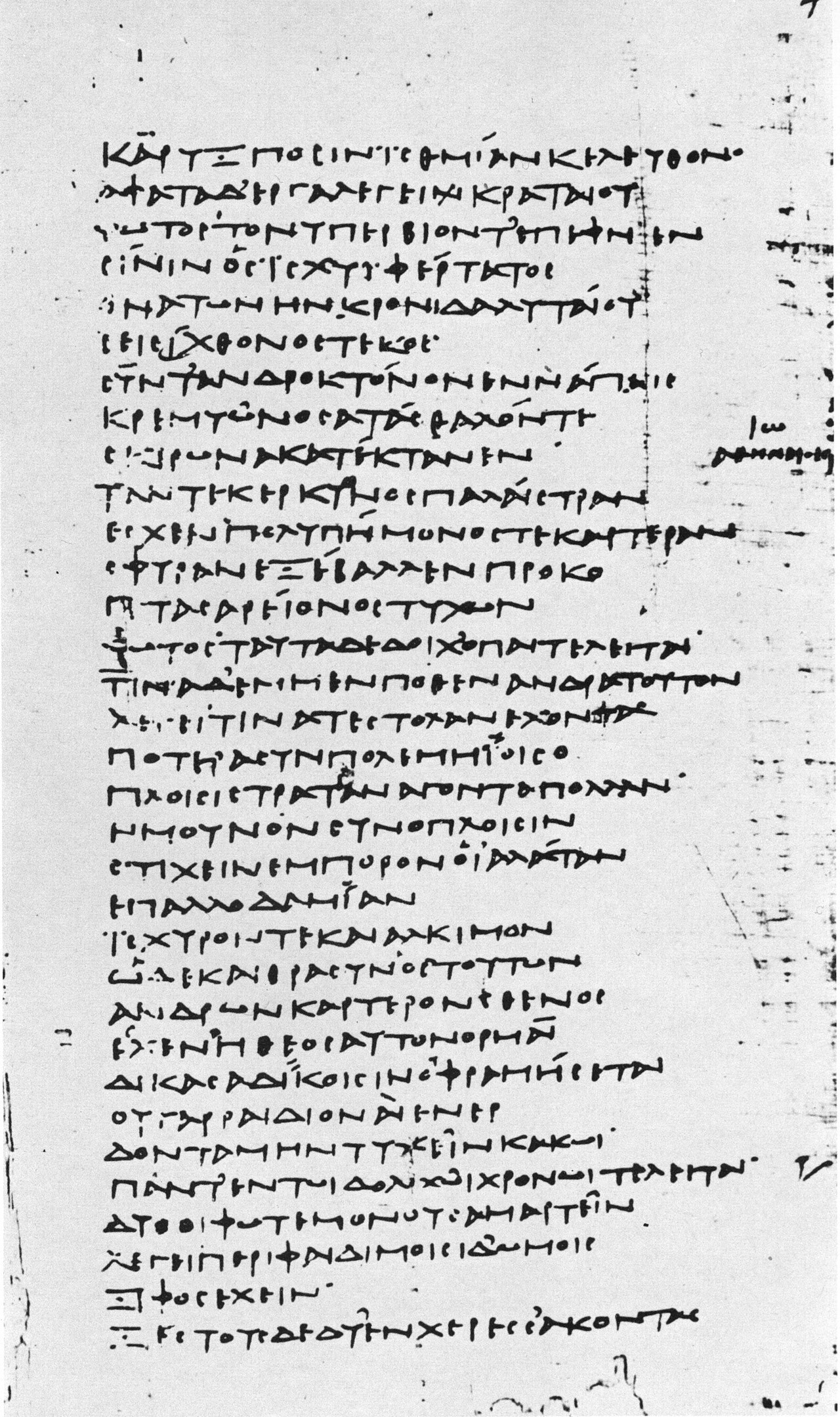
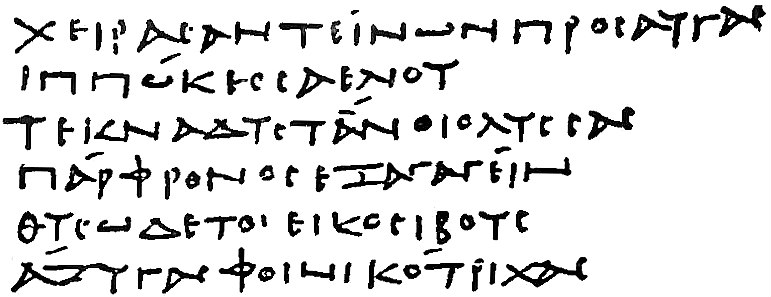
Bacchylides' significance lies in his role as a major lyric poet of the early classical period, whose works were preserved in a single papyrus discovered in the late 19th century. His lyrics are characterized by elegance and polished style, qualities noted since Longinus, though some scholars have characterized them as superficial charm. He has often been compared unfavourably with his contemporary Pindar, but translator Robert Fagles argued that such comparison is childish. His poems were collected into critical editions in the late 3rd century BC by Aristophanes of Byzantium, arranged in nine books covering various genres. His work provides an ideal introduction to Greek lyric poetry due to its clarity and simplicity. His legacy includes being one of the last significant poets of the purely lyric tradition before the ascendency of dramatic poetry. His patrons, though few, covered a wide geographical area including Delos, Thessaly, and Sicily. His lyrics were not popular in his own lifetime; no trace of his work appears until the Hellenistic age when Callimachus wrote commentaries. He only gradually acquired fame towards the end of his life.
Did You Know?
- Bacchylides was the nephew of the lyric poet Simonides.
- The claim that his grandfather, also named Bacchylides, was a famous athlete is not supported by reliable ancient sources and is considered dubious.
- Ode 17 is a dithyramb associated with Delos, not a Delian festival in Athens.
- His works were commissioned by major patrons like Hieron of Syracuse and were known and quoted throughout antiquity.
Poetic Style and the Pindar Question
Bacchylides' verse has long been defined by its clarity of expression and a certain quiet, polished elegance. Since at least the era of Longinus, scholars have remarked on the refined surface of his lyrics, though some have dismissed these qualities as mere superficial charm. The most persistent critical comparison has been with his contemporary Pindar, with one scholar famously likening Bacchylides to a Boccherini set against Pindar's Haydn. Yet translator Robert Fagles pushed back against such hierarchy, arguing that faulting Bacchylides for lacking Pindar's grandeur is as juvenile as condemning Marvell for missing Milton's scope. The two poets' styles resist easy juxtaposition. What Bacchylides offers instead is a gentler, more approachable lyricism—simple in thought, lucid in phrasing—qualities that have made his odes a natural entry point for students encountering Greek lyric poetry for the first time, and a useful companion to the more demanding Pindaric corpus.
The Island of Keos and a Poet's Formation
Bacchylides was born around 518 BC in Ioulis on the small island of Keos, a place steeped in musical and poetic tradition. His mother was the sister of Simonides, the celebrated lyric poet, and the island itself maintained a deep association with Delos, the great Ionian sanctuary where Cean choirs performed annually in festivals honoring Apollo. Keos boasted its own thriving Apollonian cult, a training ground for choruses at Carthaea where Simonides had once taught, and a proud athletic heritage in running and boxing. Victory slabs at Ioulis recorded the island's triumphs at the Isthmian Games, and Ceans could point to their role in the Persian Wars, including an elegy by Simonides chosen by Athens to mourn the fallen at Marathon. Situated just thirteen miles from the Athenian cape Sunium, Keos was inevitably shaped by Athenian cultural currents. It was in this rich, competitive, artistically fertile environment that a boy of quick imagination found his natural home.
Career, Patrons, and the Shadow of Drama
Bacchylides composed his lyrics for a small but geographically dispersed circle of elite patrons stretching from Delos in the Aegean to Thessaly on the mainland and as far west as Sicily and Magna Graecia. His career was significantly shaped by the prestige of his uncle Simonides, whose existing patronage networks—including connections to the Athenian court under Hipparchus—opened doors for the younger poet. Simonides introduced Bacchylides to Thessalian ruling families and to Hieron of Syracuse, whose dazzling court also attracted Pindar and Aeschylus. His first major commissions, arriving after 500 BC, included a song for the great Delian festival in Athens (Ode 17) and a symposium piece for the young Macedonian prince Alexander I. Yet his work never achieved the broad popular recognition enjoyed by Pindar or Simonides in their own day; no Athenian parody, no Platonic quotation, no party performance bears his name. His career unfolded against the rising tide of dramatic poetry, and he is rightly regarded as one of the last major voices in the older tradition of purely lyric verse.
Obscurity in Life, Rediscovery in Scholarship
Perhaps the most striking fact about Bacchylides is the gap between his canonical status and his apparent obscurity during his own lifetime. While Pindar's odes were sung at symposia, parodied by Aristophanes, and quoted by Plato, no trace of Bacchylides' work survives in Athenian literary culture until the Hellenistic period, when Callimachus began composing commentaries on his verses. Modern editor Richard Claverhouse Jebb, piecing together the poet's scattered fragments, described him as placid, amiably tolerant, content with a modest lot, and touched by the pensive melancholy characteristic of Ionian sensibility. Later Greek scholars enshrined him among the Nine Lyric Poets alongside his uncle, securing his place in the literary canon. His death date remains uncertain—Jebb proposed 428 BC, while a date near 451 BC is more widely accepted—and some evidence suggests he may still have been alive when the Peloponnesian War erupted. An ancient tradition, supported by Jebb and others, holds that he was younger than Pindar, though most modern scholars treat them as exact contemporaries.
Gallery


Frequently Asked Questions
What distinguishes Bacchylides's poetic style?
His lyrics are prized for their clear, unadorned expression and straightforward simplicity of thought. Because of that accessibility, scholars frequently point to his work as a natural entry point for anyone studying Greek lyric poetry.
What was the rivalry between Bacchylides and Pindar?
Both were leading lyric poets working in the same era, and later tradition framed them as competitors vying for the patronage of wealthy aristocratic families. Their pairing remains one of the most frequently cited competitive relationships in Greek literary history.
Where was Bacchylides from, and what was his family background?
He was born in Ioulis on the Aegean island of Keos. His uncle was Simonides, another member of the canonical Nine Lyric Poets, which gave the family a well-known literary reputation in the ancient world.
More in Poets Of The Ancient World 1-17
Spotted an error? Know more?
This is a living reference — every entry is fact-audited, and reader corrections feed straight into our audit queue. Suggest an edit · See this site's audit record