
Aratus
Greek didactic poet known for his astronomical poem *Phenomena*.

NASA/GSFC/Arizona State University · Public domain
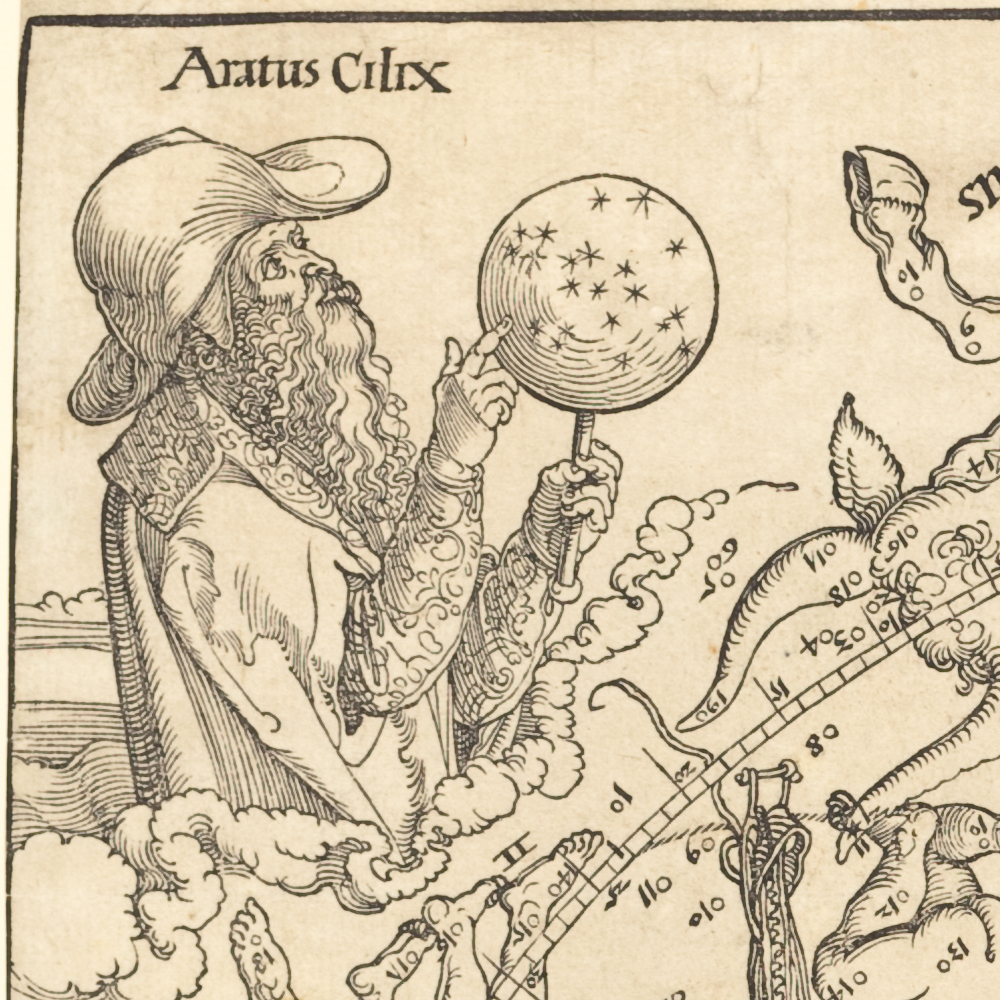
Aratus (c. 315/310 – 240 BC) was a Greek didactic poet from Soli in Cilicia. His major extant work is the hexameter poem *Phenomena*, which describes constellations and other celestial phenomena, and the *Diosemeia*, which focuses on weather lore. Although somewhat ignorant of Greek astronomy, his poem was highly popular in the Greek and Roman world, as evidenced by numerous commentaries and Latin translations.
- born
- c. 315/310 BC
- died
- 240 BC
- field
- Didactic poetry, astronomy, weather lore
- nationality
- Greek (from Soli, Cilicia)
- known_for
- Hexameter poem *Phenomena* and *Diosemeia*
Lore & Background
Aratus was a native of Soli in Cilicia, though one authority says Tarsus. He studied with Menecrates in Ephesus and Philitas in Cos, and as a disciple of the Peripatetic philosopher Praxiphanes in Athens, he met the Stoic philosopher Zeno, as well as Callimachus and Menedemus. He was the son of Athenodoros and had a brother of the same name. At this court he wrote his most famous poem, *Phenomena*. He later spent time at the court of Antiochus I Soter of Syria, then returned to Pella in Macedon, where he died around 240 BC. Ancient sources identify him solely as a poet, with no evidence that he pursued medicine, grammar, or philosophy as chief interests.
Reader's Guide
Aratus's significance lies in the immense popularity of his *Phenomena* and *Diosemeia* in the Greek and Roman world. The *Phenomena* versified a lost work by Eudoxus of Cnidus, providing an introduction to constellations and celestial circles, though it lacked scientific accuracy. The *Diosemeia* offered weather forecasts from astronomical phenomena, imitating Hesiod and influencing Virgil's *Georgics*. Despite his ignorance of astronomy, the poems attracted numerous commentators and Latin translators, including Cicero, Ovid, Germanicus, and Avienius. The poems were cited by Luke the Evangelist in Acts 17:28, and an Arabic translation was commissioned in the ninth century.
Did You Know?
- Aratus's *Phenomena* is based on a lost prose work of the same name by Eudoxus of Cnidus.
- Latin translations of Aratus were made by Cicero, Ovid, Germanicus, and Avienius.
- Aratus is cited in the New Testament, in Acts 17:28, during Paul's address on the Areopagus.
Origins, Education, and Royal Patronage
Aratus was born around 315 or 310 BC in Soli, a city in Cilicia, though one ancient authority places his birthplace at Tarsus. His father bore the name Athenodoros, and a brother shared that same name. His intellectual formation stretched across several cities: he studied under Menecrates in Ephesus and under Philitas on the island of Cos. In Athens he became a student of the Peripatetic thinker Praxiphanes, and in that environment his circle of acquaintances included the Stoic founder Zeno, the poet Callimachus of Cyrene, and Menedemus, who would go on to establish the Eretrian school of philosophy. Beyond verse, Aratus devoted himself to medicine—which some sources identify as his actual profession—as well as to grammar and philosophy. Around 276 BC the Macedonian king Antigonus II Gonatas summoned him to his court at Pella. There Aratus composed a verse celebration of Antigonus's 277 BC victory over the Gauls and, more significantly, wrote his masterwork, the Phenomena. He later spent a period at the Syrian court of Antiochus I Soter before returning to Pella, where he died sometime before 240 or 239 BC.
The Phenomena: Versifying the Heavens
The Phenomena, a hexameter poem of 732 lines, was composed at the request of Antigonus II Gonatas, who wished to see two earlier prose treatises by Eudoxus of Cnidus—his own Phenomena and a work called Enoptron, meaning 'Mirror'—rendered into verse. Aratus drew heavily on both, though the first served as his primary source. The poem's stated aim is to introduce readers to the constellations, the rules governing their risings and settings, and the great circles of the celestial sphere, including the Milky Way. Constellations north of the ecliptic are located by reference to the polar groups: Ursa Major, Ursa Minor, Draco, and Cepheus, while Orion anchors the southern sky. The work affirms the Earth's stillness and the sky's rotation about a fixed axis, traces the Sun's yearly path through the zodiac, and mentions the planets only as bodies with independent motion, without specifying their periods or the Moon's orbit. Its opening lines declare that all things depend upon Zeus. Hipparchus, writing roughly a century later, catalogued numerous inaccuracies in the descriptions—errors inherited from Eudoxus and compounded by Aratus's own handling of the material—confirming that the poet was neither a mathematician nor a careful observer.
Diosemeia: Weather, Animals, and Ancient Authority
The second poem, the Diosemeia, spans 422 hexameter lines and focuses on reading weather signs from celestial phenomena, along with the effects of weather upon animals. Although later readers often treated the Phenomena and Diosemeia as a single unified work, they appear to be distinct compositions. The Diosemeia is explicitly modeled on Hesiod's earlier verse concerning agricultural and meteorological signs, and its raw material is drawn almost entirely from three prose sources: Aristotle's Meteorologica, Theophrastus's treatise On Weather Signs, and Hesiod himself. Notably, neither poem engages with Hellenistic astrology; their concern is practical observation rather than divination. The Diosemeia's influence on later literature is significant: Virgil borrowed from it in portions of the Georgics, making Aratus an indirect ancestor of Roman pastoral and agricultural poetry. The Suda also lists a long catalogue of other works attributed to Aratus—hymns, epigrams, prose letters, an anatomical text, and a correction of the Odyssey—none of which survive, leaving the two astronomical poems as his sole extant literary legacy.
Enduring Prestige and the Latin Reception
Aratus's two poems achieved extraordinary popularity across the Greek and Roman literary worlds, a fact attested by the sheer volume of ancient commentaries and the number of Latin translations that were produced. Among Hellenistic poets he commanded immense prestige: Theocritus, Callimachus, and Leonidas of Tarentum all acknowledged his authority. That reputation carried seamlessly into Latin letters, where Ovid and Virgil both cited him. Four major Latin versions were attempted: Cicero's (mostly surviving), Ovid's (only two brief fragments remain), the version by Germanicus of the Julio-Claudian imperial family (extant with accompanying scholia), and that of the lesser-known Avienius (also extant). The Roman rhetorician Quintilian, however, was noticeably less enthusiastic about the poet's merits. Aratus's influence even crossed into religious literature, as the author of the Gospel of Luke and the Acts of the Apostles cited him. A printed Latin edition appeared in Leiden from the Officina Plantiniana in 1600, testifying to the poem's continued scholarly interest into the early modern period.
Gallery

Frequently Asked Questions
Who is Aratus?
Aratus was a Greek didactic poet from Soli in Cilicia (c. 315–240 BC) who wrote verse about the night sky and weather patterns. He is best remembered for his hexameter poem *Phenomena*.
What did Aratus actually write?
Two works survive: *Phenomena*, a long hexameter poem cataloguing constellations and celestial events, and *Diosemeia*, a shorter piece devoted to reading weather signs. Both are instructional in tone rather than narrative.
Why was Aratus so widely read if he wasn't a great astronomer?
His real gift was making complex sky-lore feel approachable through plain, rhythmic hexameter verse. That accessibility earned him a huge readership across the Greek and Roman worlds, spawning many commentaries and Latin translations.
Where was Aratus from?
He was born in Soli, a city on the Cilician coast in what is now southern Turkey, and is generally identified as a Greek-speaking poet of that region.
What is Aratus's lasting legacy?
*Phenomena* became the go-to poetic reference for naming and describing constellations, and its popularity persisted well into the Roman era through scholarly glosses and verse translations.
More in Poets Of The Ancient World 1-17
Spotted an error? Know more?
This is a living reference — every entry is fact-audited, and reader corrections feed straight into our audit queue. Suggest an edit · See this site's audit record